
How I Would Build YouTube's Copyright Matching System
Read this first. I do not work at Google and I have no access to YouTube's Content ID implementation. This is not a leaked specification. It is my own architectural interpretation — how I would design a system to solve this problem at this scale, built from publicly available research and standard large-scale search techniques. The numbers throughout are illustrative, not measured. I explain exactly what is known versus what is my reasoning in the What This Is, And Isn't section at the end.
Everyone says "YouTube scans your video for copyright."
It doesn't. YouTube never actually watches your video.
That sentence sounds like a technicality. It isn't. It is the entire design. Once you understand why the system cannot watch your video, every other strange thing about copyright claims suddenly makes sense — why a three-second clip gets caught, why speeding up audio doesn't help, why a video you uploaded five years ago can get claimed tomorrow morning.
This article walks through the whole thing from the ground up. I assume you know nothing about audio processing, hashing, or search infrastructure. Every technical term gets defined the moment it appears, with an example you can picture.
Table of contents
The number that breaks everything
Let's start with the constraint that forces every decision that follows.
Two facts:
Roughly 720,000 hours of video are uploaded to YouTube every day.
There are more than 100 million reference files in the system.
What is a "reference file"?
This is the first term worth nailing down, because almost everyone gets it wrong.
A reference file is not every video on YouTube. It is an original, official file that a copyright owner — a record label, a film studio, a TV network, an independent musician — has handed to YouTube and said: "This is mine. Please protect it."
Think of it as a wanted poster. A police station doesn't have a poster for every person in the city. It has posters only for the specific people it has been asked to look for. Your upload is a new face walking through the door. The system checks that face against the posters — not against the whole city.
So the matching problem is: for every new upload, check it against 100 million wanted posters.
The naive approach, and why it dies immediately
The obvious way to do this is to compare each upload against each reference file, one at a time.
100,000,000  reference files it could match
×          1  new upload
= 100,000,000  comparisons, for a single video
Suppose one comparison takes 1 millisecond. That's generous — comparing two pieces of media properly takes far longer than a millisecond, but let's be kind to the naive design.
100,000,000 comparisons × 1 ms = 100,000,000 ms
                                = 27.7 hours
Twenty-seven hours to check one upload. And thousands arrive every minute.
In computer science terms, this is an O(n × m) problem.
What does O(n × m) mean? This is Big O notation — a way of describing how the work grows as the input grows. It ignores constants and hardware speed and describes only the shape of the growth.
O(n) means "the work grows in a straight line with the input." Ten times more input, ten times more work.
O(n × m) means the work is the product of two things. Here, n is the number of uploads and m is the number of reference files. Double the references and double the uploads, and the work goes up four times.
That multiplication is the killer. Every new reference file added to the system makes every future upload more expensive to check. The system gets slower the more successful it becomes — which is the worst possible property for something meant to run forever.
This isn't slow. It is impossible. No amount of extra servers fixes a shape like this; you'd need to grow your fleet faster than your own catalogue grows, forever.
So the naive design is dead. Everything that follows exists to escape this one equation.
The one idea the whole system rests on
Here is the move that makes the impossible tractable:
Stop comparing videos. Compare short codes.
You cannot search 100 million videos one by one. But you can look up one short code in an index — instantly, without touching anything else.
If you have ever used the index at the back of a textbook, you already understand the entire architecture. The index doesn't make you read every page to find the word "photosynthesis." You look the word up, and it tells you: pages 5, 12, and 40. You go straight there.
The whole engineering challenge is therefore:
How do you turn a video into a small set of "words" that can be looked up in an index — in a way that still works after the video has been re-encoded, cropped, sped up, or had someone talking over it?
That is it. That is the entire problem. The rest of this article is the answer.
The payoff, to keep in mind as we go:
| Approach | Time to check one upload |
|---|---|
| Compare against everything | ~27 hours |
| Look up codes in an index | ~40 milliseconds |
That's roughly 2.4 million times faster — achieved not by better hardware, but by changing the shape of the problem from O(n × m) to something close to O(log m).
What does O(log m) mean? Logarithmic growth. It means that as the data multiplies, the work only creeps up. Going from 1 million to 100 million references — a 100× increase — barely changes the lookup cost. This is the growth curve every large-scale search system is trying to reach, and it is why search engines can return results from billions of pages in a fraction of a second.
The architecture: two pipelines, one index
Before we get into the signal processing, here is the shape of the whole system. There are two separate flows, and they share exactly one thing.
Pipeline 1 — Onboarding (runs once per reference file)
Copyright owner → Human review → Original file → Make fingerprint → Store in index
This pipeline is slow, rare, and human-gated. A copyright owner applies for access. A human team at YouTube reviews whether they actually own a substantial catalogue and whether they have a history of their work being re-uploaded. Ownership is also scoped by territory, because rights differ country to country — a label might own a song in Germany but not in Japan.
Only after approval does the file get fingerprinted and added to the index.
This human gate is the reason an ordinary creator can't simply request Content ID access. That is not a technical limitation. It is a deliberate trust boundary: an automated claiming system that anyone could join would be abused within a day.
Pipeline 2 — Matching (runs on every single upload)
Your upload → Make fingerprint → Look up in index → Verify → Decide
This pipeline is fast, constant, and fully automatic. It runs on everything, in milliseconds, with no human involved.
The shared contract
The two pipelines have opposite priorities. Onboarding cares about correctness far more than speed — a bad reference file poisons every future match. Matching cares about speed far more than perfection — it has to keep up with a firehose.
They can have opposite priorities because they agree on exactly one thing: the fingerprint format.
That single agreement is what lets each side scale independently. Onboarding can take a week over one file. Matching can process a thousand uploads a second. Neither needs to know anything about how the other works, as long as both produce and consume the same kind of fingerprint.
This is a general architecture lesson worth taking away from the article even if you never touch media: when two systems have incompatible performance requirements, don't compromise between them — give them a narrow shared data contract and let each optimise for its own constraint.
Our running example
To keep everything concrete, one example runs through the rest of this article:
my_video.mp4— 10 minutes long. Somewhere inside it, starting at 04:12, there are 8 seconds of a copyrighted song.
One clarification, because this trips people up: the system processes the entire 10-minute video. We are zooming in on those 8 seconds only because that's the part that will produce a match. The rest of the video is fingerprinted too — it just doesn't match anything.
Analogy: a metal detector sweeps the whole beach. We're only paying attention to the moment it beeps.
Step 1: Sound is just a list of numbers
Before a computer can fingerprint audio, it has to hold audio. So: what is audio, to a computer?
Sound is vibrating air
When something makes a noise, it pushes the air around it. That push travels outward as a wave of changing air pressure. Your eardrum moves in response, and your brain interprets that movement as sound.
A microphone does the same thing, except instead of a brain it has a wire. It measures the air pressure and reports a number. High pressure, high number. Low pressure, low number.
Sampling: taking snapshots
A computer can't store a continuous, smoothly-changing wave. It has to store discrete numbers. So it takes rapid measurements — samples — and stores each one.
Term: sample rate. The number of measurements taken per second. CD-quality audio uses 44,100 samples per second (written 44.1 kHz). That number isn't arbitrary: human hearing tops out around 20,000 Hz, and a mathematical result called the Nyquist theorem says you need to sample at more than twice the highest frequency you want to capture. 44,100 comfortably clears twice 20,000.
Term: channels. Stereo audio has 2 channels — one for the left ear, one for the right. Each channel is measured independently, so a stereo recording produces two full streams of numbers.
Now we can do the arithmetic on our 8-second clip:
        8 seconds
×  44,100 samples per second
×       2 channels
= 705,600 numbers
At roughly 2 bytes per sample, that's about 1 MB for 8 seconds of sound.
Those numbers look something like this:
[-0.02, 0.41, 0.38, -0.91, -0.55, 0.12, 0.77, ...]
Why you can't just compare these numbers
Here's the problem. Re-save that audio file — export it at a different bitrate, upload it to a platform that re-encodes it, convert MP3 to AAC — and every single one of those 705,600 numbers changes.
Not a few of them. All of them. Lossy compression reconstructs an approximation of the wave, not the wave itself. Two files that sound identical to a human can share almost no exact sample values.
So byte-by-byte comparison is useless before we even start. We need something that captures what the audio sounds like, not what it literally contains.
Slicing it into overlapping chunks
Eight seconds of sound is far too much to analyse in one go — a song changes constantly, and a single summary of the whole clip would blur everything together. So we chop it up.
Term: window (or frame). A short slice of audio analysed as a unit. Here, 2,048 samples — about 46 milliseconds of sound.
Term: hop size. How far we slide forward before taking the next window. Here, 512 samples.
Notice that the hop (512) is smaller than the window (2,048). That means consecutive windows overlap — each new window shares three quarters of its content with the previous one.
Analogy: imagine reading a long sentence through a magnifying glass that shows five words at a time. If you jumped forward exactly five words each time, you'd risk slicing a phrase in half at the boundary and never seeing it whole. So instead you slide forward by one or two words, and the views overlap. Nothing important falls between the cracks.
How many windows does that give us?
8 seconds × 44,100 samples/sec = 352,800 samples (per channel)
352,800 ÷ 512 (hop size)       ≈ 688 windows
Our 8-second clip becomes about 688 overlapping chunks.
Step 2: Those numbers become a picture
This is the pivotal move in the whole design, and it's worth slowing down for.
For each of those 688 chunks, the computer asks one question:
Which pitches are present in this chunk, and how loud is each one?
From a wave to a set of pitches
Any sound, however messy, can be broken down into a combination of pure tones at different frequencies. A piano chord is several pure tones stacked. A drum hit is a huge spread of frequencies all at once. A human voice is a fundamental tone plus a characteristic pattern of overtones.
Term: Fourier transform. The mathematical operation that takes a chunk of a wave and returns how much energy it contains at each frequency. You hand it a 46-millisecond slice of sound; it hands you back a list like "lots of energy at 110 Hz, some at 220 Hz, a little at 440 Hz, almost nothing above 8,000 Hz." In practice, computers use a fast version called the FFT (Fast Fourier Transform), which is what makes this feasible to run millions of times a second.
Run the Fourier transform on each of the 688 chunks and you get 688 lists of frequency energies. Stack those lists side by side, in time order, and you have a two-dimensional grid.
The spectrogram
Term: spectrogram. A picture of sound. Time runs left to right. Pitch runs bottom (low) to top (high). Brightness is loudness.
For our clip, that grid is roughly 688 columns × 1,025 rows — about 1.4 MB as an image.
A spectrogram of 8 seconds of music
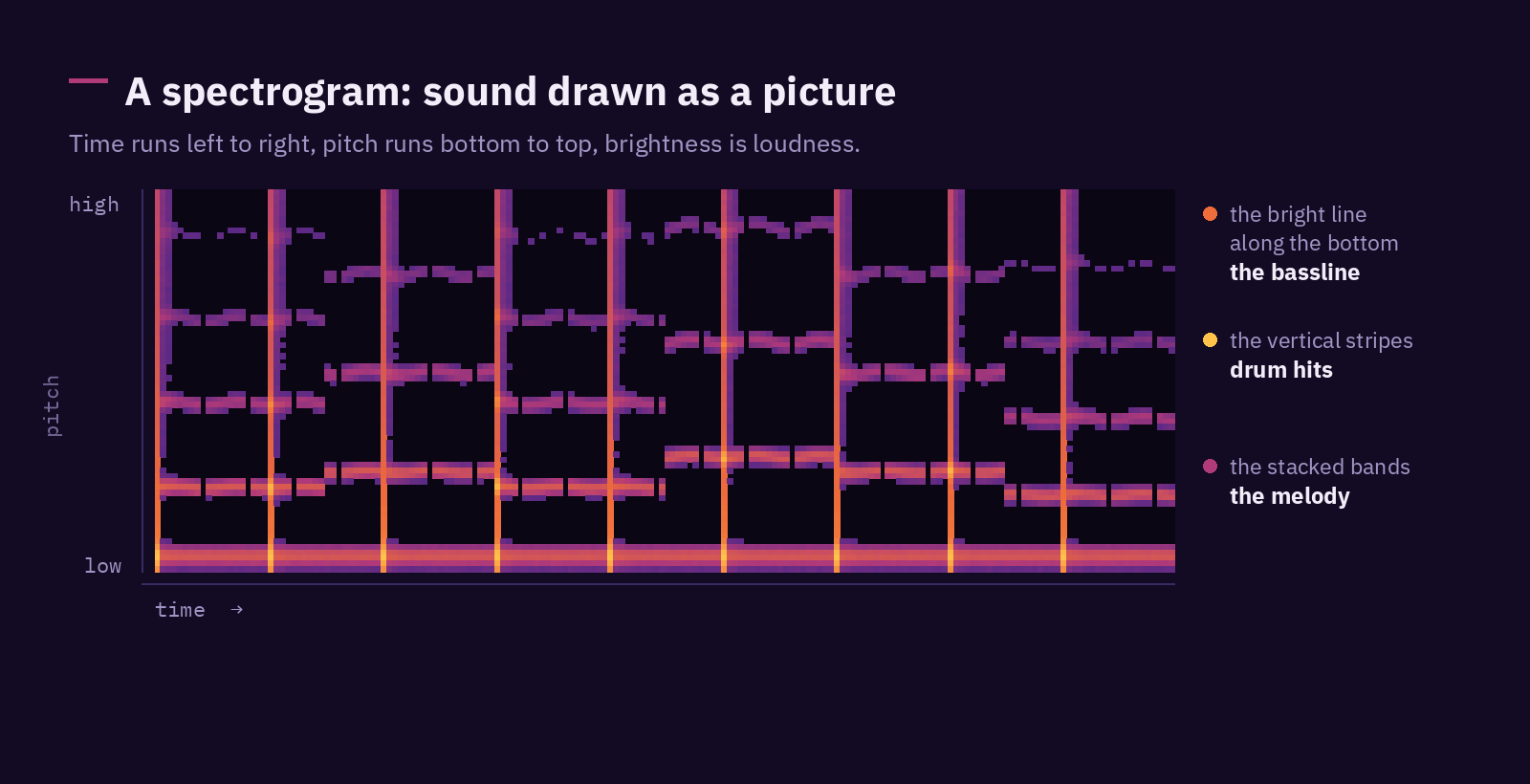
If you know what to look for, a spectrogram is remarkably readable:
| What you see | What it is |
|---|---|
| A bright horizontal line along the bottom | The bassline — a sustained low frequency |
| Sharp vertical stripes | Drum hits — a burst of energy across all frequencies at one instant |
| Stacked horizontal bands that shift together | The melody and its harmonics |
| Dark areas | Silence, or frequencies with no energy |
This is the key insight of the entire system:
Sound has been turned into an image. And image matching is a problem computer science is extremely good at.
We've converted an unfamiliar problem (comparing audio) into a familiar one (comparing pictures), and we did it with a transformation that survives re-encoding — because two files that sound the same produce spectrograms that look the same, even if their raw samples differ completely.
Step 3: The picture becomes a fingerprint
A 1.4 MB image per 8 seconds is still far too big to search across 100 million files. We need to shrink it dramatically while keeping what makes it identifiable.
Keep only the peaks
Look at a spectrogram and you'll notice most of it is dim. Quiet background, room noise, the tail ends of frequencies. Only a relatively small number of points are genuinely loud.
So: throw away everything except the strongest peaks.
Full spectrogram versus only its loudest peaks
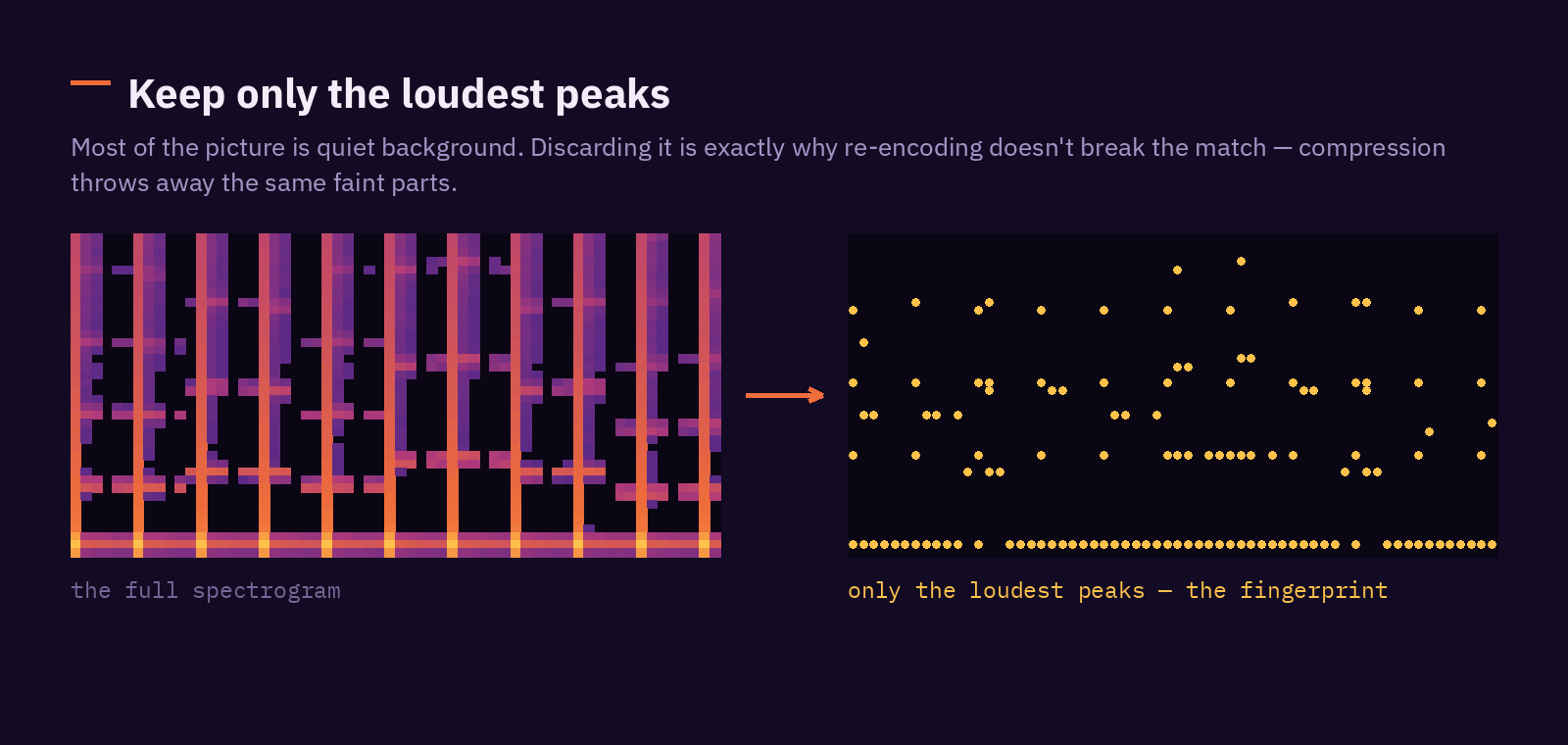
What's left looks like a constellation — a scatter of bright points across time and pitch.
This step is doing more work than it appears to. Here is the crucial consequence:
This is precisely why re-encoding doesn't break the match.
Lossy compression works by discarding the parts of a signal humans are least likely to notice — which is to say, the quiet parts. We threw those away first. The compressor and the fingerprinter are, by coincidence, deleting the same information. So the peaks survive.
The same logic explains resilience to background noise. If someone is talking over the music, their voice adds new energy, but it doesn't usually remove the loud musical peaks that were already there. Most of the original constellation is still present.
Turning peaks into codes
Now we convert those peaks into short text codes that can go into an index.
The general technique here is called hashing.
Term: hash. A function that takes some input and produces a short, fixed-size code from it. You hand it something big and messy; it hands back something small and tidy that stands in for it.
But — and this is the critical detail — we need a particular kind of hash. We'll come back to why in the index section, because it's the single most important design choice in the system.
For now, the result:
Our 8 seconds of music  →  about 200 short codes

0x8F2A41   0x1C09BE   0x77D3A0   0x4E1182   ...
Roughly one code for every 46 milliseconds of sound.
What is
0x8F2A41? The0xprefix just means "this number is written in hexadecimal" — base 16, using digits 0-9 and letters A-F. Programmers use hex because it's a compact way to write binary data.0x8F2A41is just a number; it has no meaning you could interpret by looking at it. Think of it as a licence plate: an arbitrary but unique-ish label for that particular 46 milliseconds of sound.
The size collapse
Here's what we've achieved, measuring the same 8 seconds three ways:
| Stage | What it is | Size |
|---|---|---|
| Raw audio | 705,600 numbers | ~2.8 MB |
| Spectrogram | 688 × 1,025 picture | ~1.4 MB |
| Fingerprint | 200 short codes | ~800 bytes |
About 3,500 times smaller than the original audio — and it still identifies the song.
That compression ratio is what makes a 100-million-file index physically possible to hold and search. You could not build this system on anything larger.
Does the fingerprint survive edits?
This is the question that decides whether the whole design works. A fingerprint that breaks the moment anyone touches the audio would be useless in practice — almost nothing on the internet is bit-identical to its source.
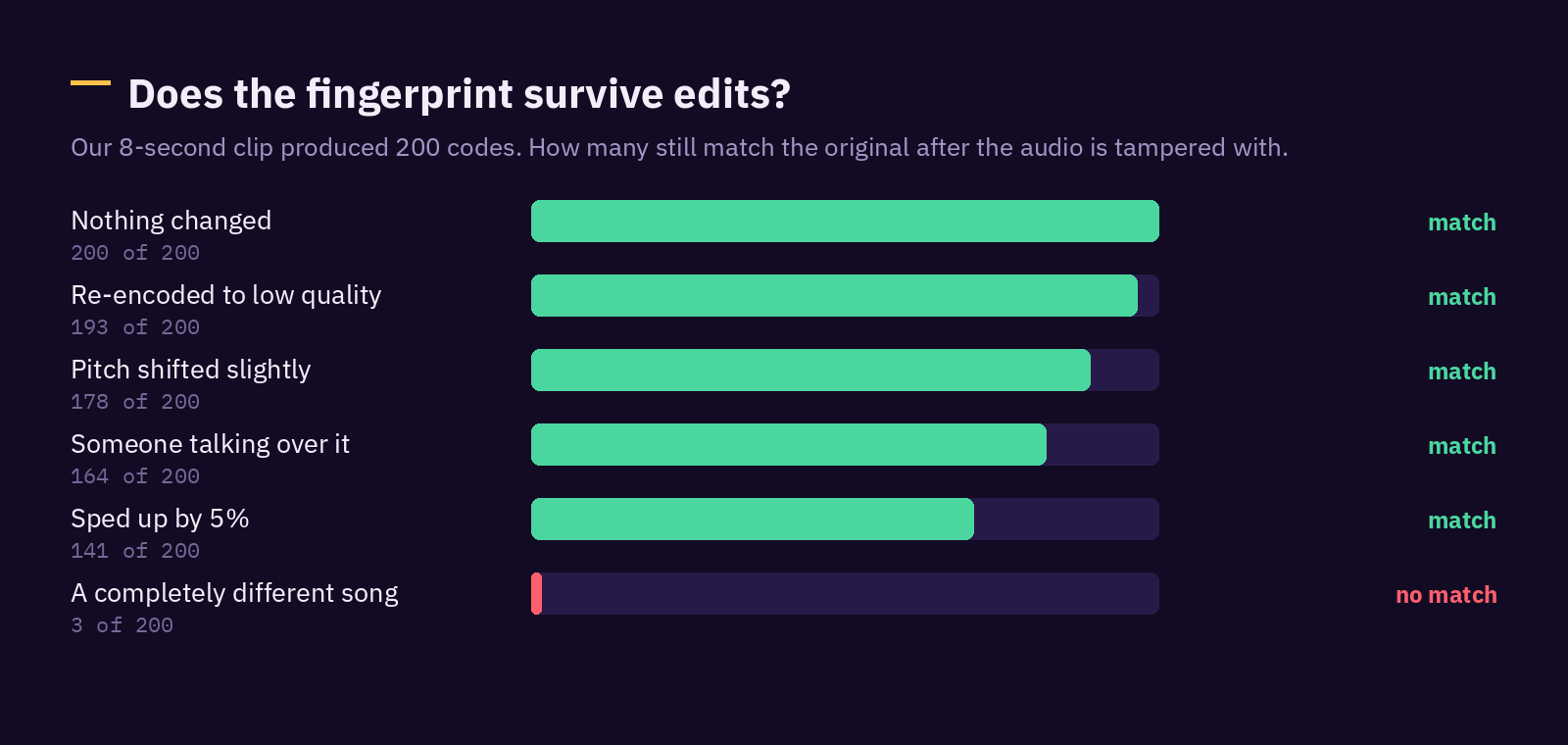
Here's how many of our 200 codes still match the original after various kinds of tampering:
| What was done to the audio | Codes still matching | Verdict |
|---|---|---|
| Nothing | 200 / 200 | Match |
| Re-encoded to low quality | 193 / 200 | Match |
| Pitch shifted slightly | 178 / 200 | Match |
| Someone talking over it | 164 / 200 | Match |
| Sped up by 5% | 141 / 200 | Match |
| A completely different song | 3 / 200 | No match |
Bar chart of fingerprint survival across different edits
Two things to notice.
First, the gap is enormous. Even the most damaged genuine copy retains 141 codes. An unrelated song retains 3 — and those three are pure coincidence, two arbitrary 46-millisecond slices of unrelated music happening to produce the same code. There is no threshold you could set between 141 and 3 that would be difficult to choose. The signal is not subtle.
Second, and this is the sentence to remember:
The fingerprint is not the audio. It is a rough summary of the audio's shape.
Nudge the audio and the shape barely moves — so the codes barely move. That tolerance is designed in, not accidental. It's also, as we'll see, the source of the system's biggest headache: a method deliberately built to tolerate differences will inevitably produce false alarms. We deal with that in the verification section.
What this means for the "5-second rule"
There is a persistent belief among creators that using under 5, or 10, or 30 seconds of copyrighted material is safe.
Nothing in this architecture supports that. The matching is pattern-based, not duration-based. A fingerprint is generated roughly every 46 milliseconds. A recognisable one-second snippet of a chorus produces around 20 codes — comfortably enough to look up and verify.
Duration affects the confidence score (a longer match scores higher, as we'll see later), and very short matches may fall below a threshold. But there is no duration that is structurally exempt. The rule does not exist because there is no mechanism in the design that could implement it.
Video: a frame becomes 64 ones and zeros
Audio is the more common case for claims, but the same philosophy applies to the picture. The steps differ; the strategy is identical.
Don't check every frame — find the scenes
A 10-minute video at 30 frames per second contains about 18,000 frames. Fingerprinting every one would be enormously wasteful, and pointless: consecutive frames in a continuous shot are nearly identical, so you'd be storing 18,000 near-copies of a few dozen distinct images.
Term: shot. A continuous run of video with no cut — the camera keeps rolling. A 10-minute video might contain 50 shots.
Term: shot detection (or scene-cut detection). Automatically finding the moments where one shot ends and another begins. The usual method is simple: compare each frame to the one before it, and when the difference spikes, you've found a cut.
Term: keyframe. One representative frame chosen from a shot — ideally a stable one, not a motion-blurred transition.
Film strip with scene cuts and one keyframe selected per shot
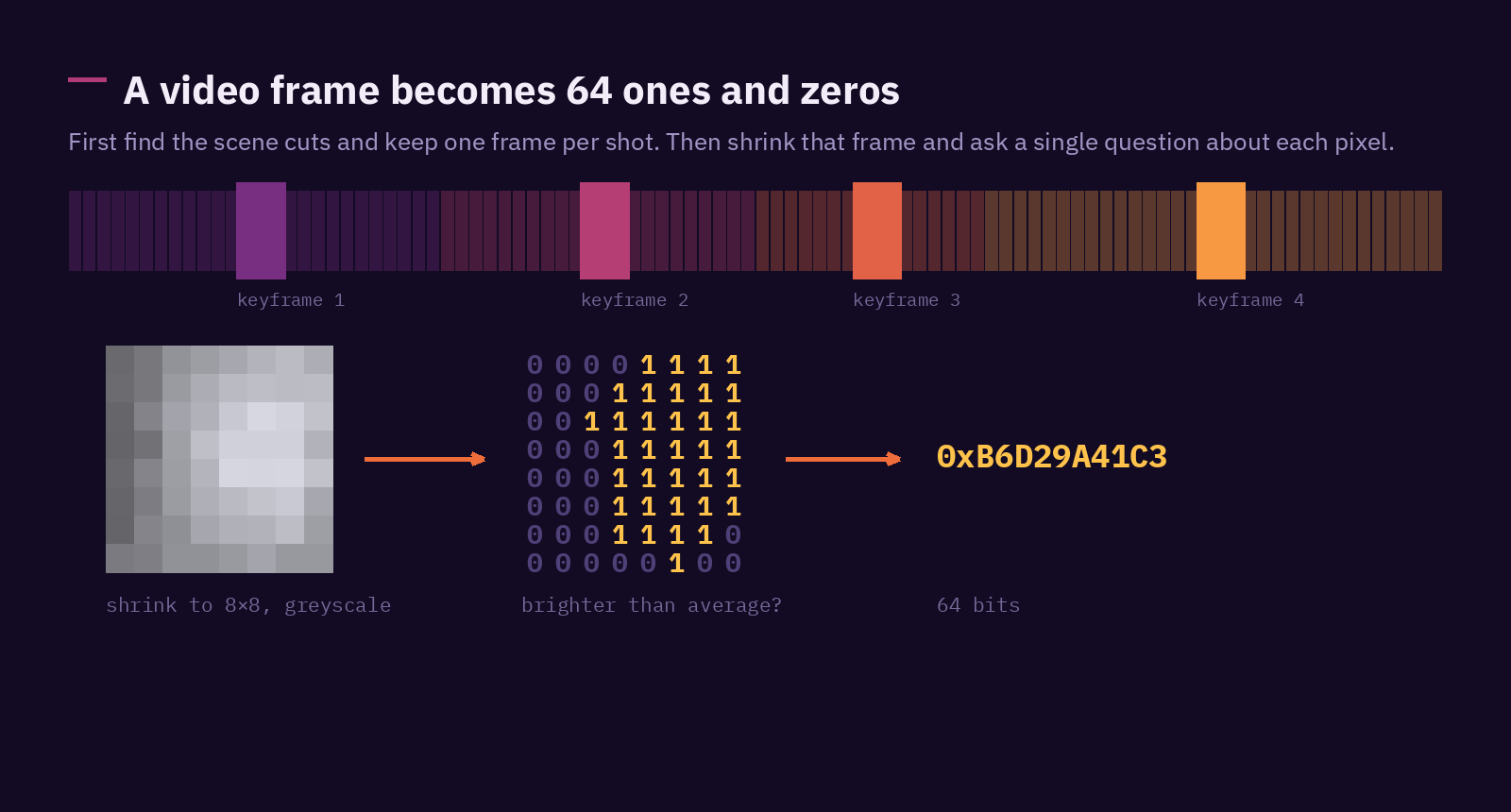
So 18,000 frames collapse to maybe 50 keyframes. Same principle as the audio peaks: keep what's distinctive, discard what's redundant.
Turning a keyframe into a code
Now we hash each keyframe. The technique is called a perceptual hash, and the simplest version works like this:
1. Shrink the image. Reduce the frame to a tiny grid — commonly 8×8 pixels. That's 64 pixels total, like a Minecraft-resolution version of the frame. All fine detail is destroyed on purpose; we only want the broad structure.
2. Convert to greyscale. Colour is fragile — it shifts with encoding, filters, and display profiles. Brightness is much more stable.
3. Calculate the average brightness of all 64 pixels.
4. Ask one question per pixel: is this pixel brighter than the image's own average?
Brighter → write 1
Darker → write 0
You now have 64 ones and zeros:
0 0 0 0 1 1 1 1
0 0 0 1 1 1 1 1
0 0 1 1 1 1 1 1
0 0 1 1 1 1 1 1      →  0xB6D29A41C3
0 0 0 1 1 1 1 1
0 0 0 1 1 1 1 0
0 0 0 0 0 1 0 0
That 64-bit code describes the shape of light and dark in the frame — not its exact pixels.
Because the question is "brighter than this image's own average," the code is naturally immune to overall brightness and contrast changes. Darken the whole frame and every pixel drops, but so does the average, so the comparisons stay the same.
Why not a normal hash?
This is where the design choice becomes obvious. Consider a cryptographic hash like SHA-256 — the kind used for passwords and file integrity:
cat.jpg                      →  3f7a9c8b12e4...
cat.jpg, one pixel changed   →  e109bb47d0a2...
Completely unrelated outputs. That is the entire point of a cryptographic hash: any change, however tiny, must scramble the result beyond recognition. It's what makes them secure.
It also makes them useless for finding similar things. Every re-encoded copy of a video would hash to something totally different from the original.
We need the opposite property:
| Tiny input change | Useful for | |
|---|---|---|
| Cryptographic hash (SHA-256) | Completely different output | Security, integrity checking |
| Perceptual hash | Almost identical output | Finding similar content |
Measuring "almost identical"
Term: Hamming distance. The number of positions at which two equal-length codes differ. Compare
1011and1001— they differ in one position, so the Hamming distance is 1.
For 64-bit perceptual hashes, typical behaviour:
| Comparison | Bits different (out of 64) | Verdict |
|---|---|---|
| Same frame, re-encoded | ~2 | Match |
| Same frame, 4K downscaled to 720p | ~4 | Match |
| Same frame, watermark added | ~6 | Match |
| Same frame, cropped 10% | ~11 | Borderline |
| Two unrelated frames | ~31 | No match |
A threshold around 10 bits separates these cleanly. Note that two random 64-bit codes differ in about 32 bits on average — half of them — which is why 31 reads as "completely unrelated" rather than "somewhat similar."
Cropping is the interesting case. Cropping shifts every pixel's position relative to the frame, which is exactly what a spatial hash is sensitive to. This is a real weakness, and we'll return to it in where this design breaks.
Why a fingerprint is a timeline, not a bag of codes
Here's a subtlety that's easy to miss, and it matters enormously.
Knowing which codes appear in a video is not enough. The system also records when each one appears.
The sentence analogy
Take three words: Dog, bites, man.
"Dog bites man" — an ordinary, unremarkable event.
"Man bites dog" — a completely different, much stranger story.
Identical words. The order changes the meaning entirely.
The same thing, with video
Imagine two videos that both contain the same three codes:
Video A (the original)
0xB6D2 ────── 0x41C3 ────── 0x9A07
 0:04          0:19          0:26
Video B (something else entirely)
0x41C3 ────── 0x9A07 ────── 0xB6D2
 0:04          0:19          0:26
Every individual code matches. If you treated a fingerprint as an unordered bag of codes, these two videos would look identical.
They are not. The sequence is different, so they're different videos — perhaps two creators who both used the same stock footage library, in different orders.
Two video timelines with the same codes in different order
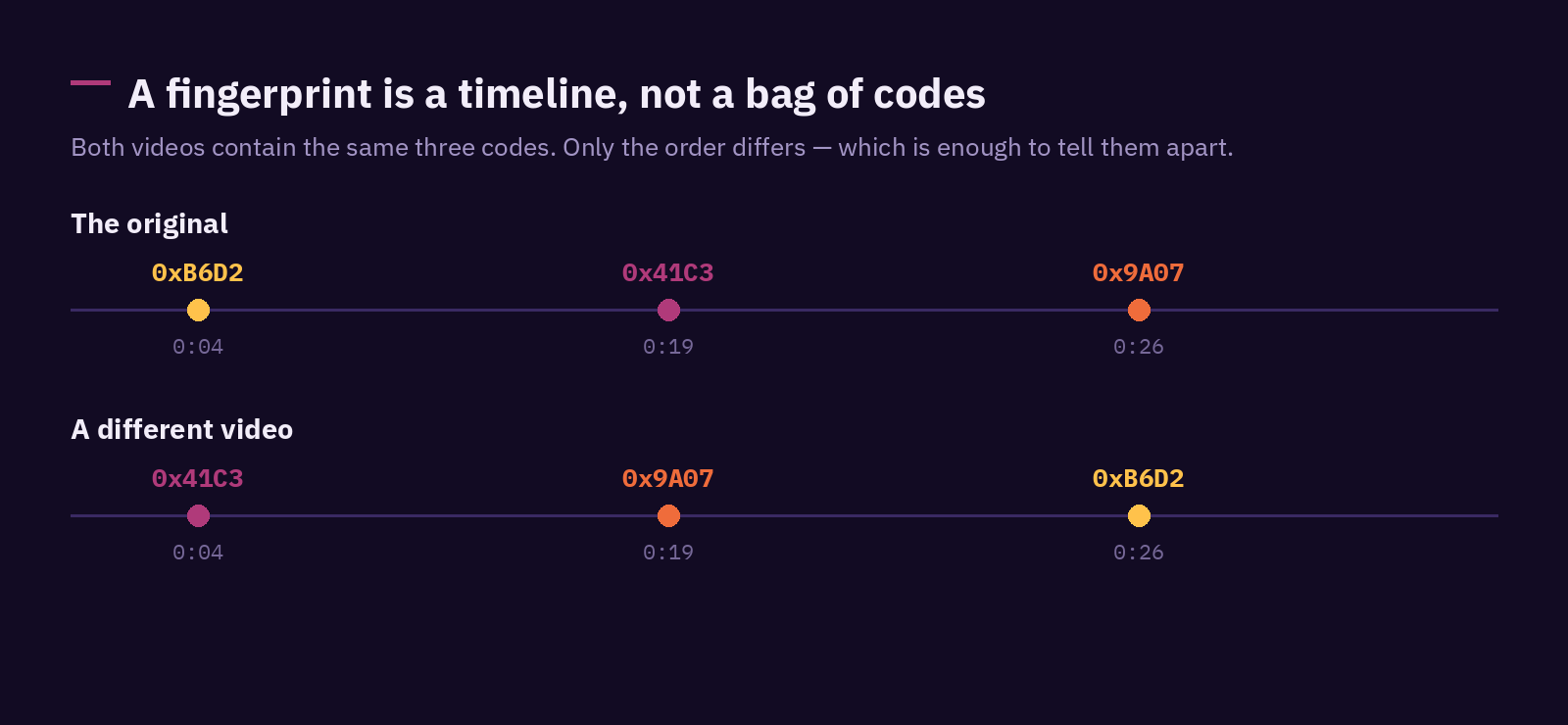
A fingerprint isn't a set of codes. It's a set of codes and their positions in time.
That timing information looks like a minor bookkeeping detail here. Hold onto it — it turns out to be the single thing that makes the entire system trustworthy, and we get to that shortly.
The index: look it up, don't scan for it
We now have fingerprints. Time to solve the actual search problem.
The wrong kind of hash — and the right one
Recall the problem with cryptographic hashes: similar inputs produce wildly different outputs. That's correct behaviour for security and wrong behaviour for us.
What we need is a family of techniques called Locality-Sensitive Hashing.
Term: Locality-Sensitive Hashing (LSH). A hashing method deliberately designed so that similar inputs land in the same bucket, with high probability, while dissimilar inputs land in different buckets.
The name is descriptive: the hash is sensitive to locality — to how close things are to each other. Ordinary hashing tries to scatter everything evenly; LSH tries to cluster similar things together.
Term: bucket. A slot in a hash table. All inputs producing the same hash value land in the same bucket.
The published research most often cited in this area is Waveprint (Baluja & Covell, 2008), a Google paper on large-scale audio fingerprinting. Its approach is to treat the spectrogram as an image, apply a wavelet transform to extract a compact description of its structure, and then use Min-Hash — an LSH technique — to convert that description into short hash tokens.
Term: wavelet transform. A way of describing an image at multiple scales simultaneously — capturing both the broad shapes and the fine details as a set of coefficients. Keeping only the largest coefficients gives a compact summary of an image's structure. It is the same family of maths behind the JPEG-2000 image format.
Term: Min-Hash. An LSH technique that estimates how much two sets overlap. Two sets sharing most of their elements will, with high probability, produce the same Min-Hash value. It's widely used for near-duplicate detection in search engines.
I want to be precise about what this citation does and doesn't establish. Waveprint is real, published, Google-authored work explicitly aimed at audio copyright protection. That makes it strong evidence of how a team at Google approached this class of problem. It is not evidence that today's production Content ID uses this algorithm. The paper is from 2008; production systems evolve continuously and are not published.
The inverted index
Term: inverted index. A data structure that maps content to the documents containing it, rather than mapping documents to their content. It is the core data structure behind every search engine.
A normal index goes: document → its words. An inverted index goes: word → the documents that contain it.
That inversion is what makes search fast. To find every page containing "photosynthesis," you don't read the pages — you look up one entry.
Here, the entries are fingerprint codes:
0x8F2A41  →  [ ref_004, ref_811, ref_297 ]
0x1C09BE  →  [ ref_004, ref_530 ]
0x77D3A0  →  [ ref_004, ref_811 ]
0x4E1182  →  [ ref_004, ref_119 ]
The index table mapping codes to reference files
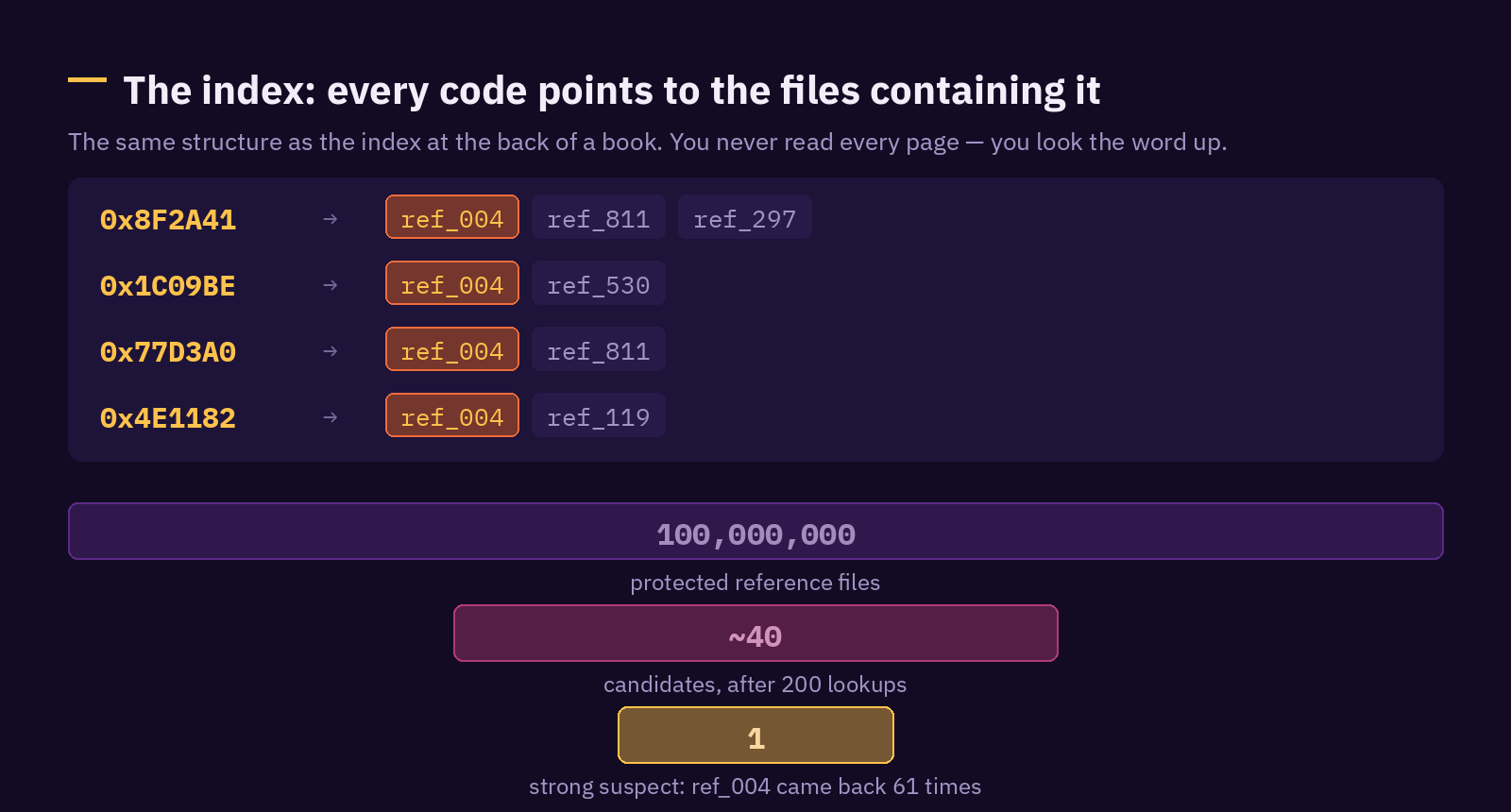
Read that carefully, because the structure is doing something specific: each row is not a second of audio. Each row is one code, and the list beside it names every reference file known to contain that code.
Our upload generated 200 codes. We look up all 200. Each lookup is essentially instant — a hash table lookup does not depend on how much data is in the table.
The funnel
100,000,000  protected reference files
      ↓  200 index lookups, no scanning
        ~40  candidate files
      ↓  count which candidates keep appearing
          1  strong suspect: ref_004 came back 61 times
Notice what just happened: we never touched the other 99,999,960 reference files. They were never loaded, never compared, never considered. That is the entire difference between 27 hours and 40 milliseconds.
And crucially, adding another 100 million reference files to the index would barely change the lookup time. The system gets better as it grows, not worse. That is the O(log m) property we were chasing at the start.
The step everyone skips: telling a copy from a coincidence
Almost every explanation of copyright matching stops at the previous section. "It makes fingerprints, it looks them up in an index, done."
That explanation is incomplete in a way that matters, because the system as described so far would produce false accusations constantly. This section is the most interesting part of the design, and it's the part I'd want to get right if I were building it.
Why a shortlist isn't proof
ref_004 came back 61 times. Is that proof?
No. And the reason is uncomfortable: we built the false alarms in on purpose.
Go back to what we designed. We deliberately made the hashing fuzzy so that similar audio would produce the same codes — that's the only reason re-encoding and pitch-shifting don't break the match. But "similar things collide" and "unrelated things sometimes collide" are the same property viewed from two sides. You cannot have tolerance without collisions.
Remember the survival table: a completely unrelated song still matched 3 of our 200 codes. Scale that across 100 million reference files and a constant stream of uploads, and coincidental collisions aren't rare — they're guaranteed, at volume.
So we need a second, independent check. One that a coincidence cannot pass.
The time gap test
Here is where the timing information from earlier finally pays off.
For every matching code, record two things: where it appeared in the upload, and where it appears in the reference file. Then subtract.
| Code | In your video | In the original | Gap |
|---|---|---|---|
0x8F2A41 |
04:12.0 | 00:47.0 | +3m 25s |
0x1C09BE |
04:13.4 | 00:48.4 | +3m 25s |
0x77D3A0 |
04:15.1 | 00:50.1 | +3m 25s |
0x4E1182 |
04:18.9 | 00:53.9 | +3m 25s |
58 of the 61 matching codes agree on the same gap.
That is not a coincidence. That is a copy.
Term: temporal-offset voting. Each matching code casts a "vote" for the time offset it implies. If a large number of votes cluster on one offset, the match is real. If the votes scatter, it's noise.
Why this works — the intuition
Think about what each scenario looks like when you plot it. Put time-in-your-video on one axis and time-in-the-original on the other, and drop a dot for every matching code.
Scatter plots: random coincidence versus a real copy
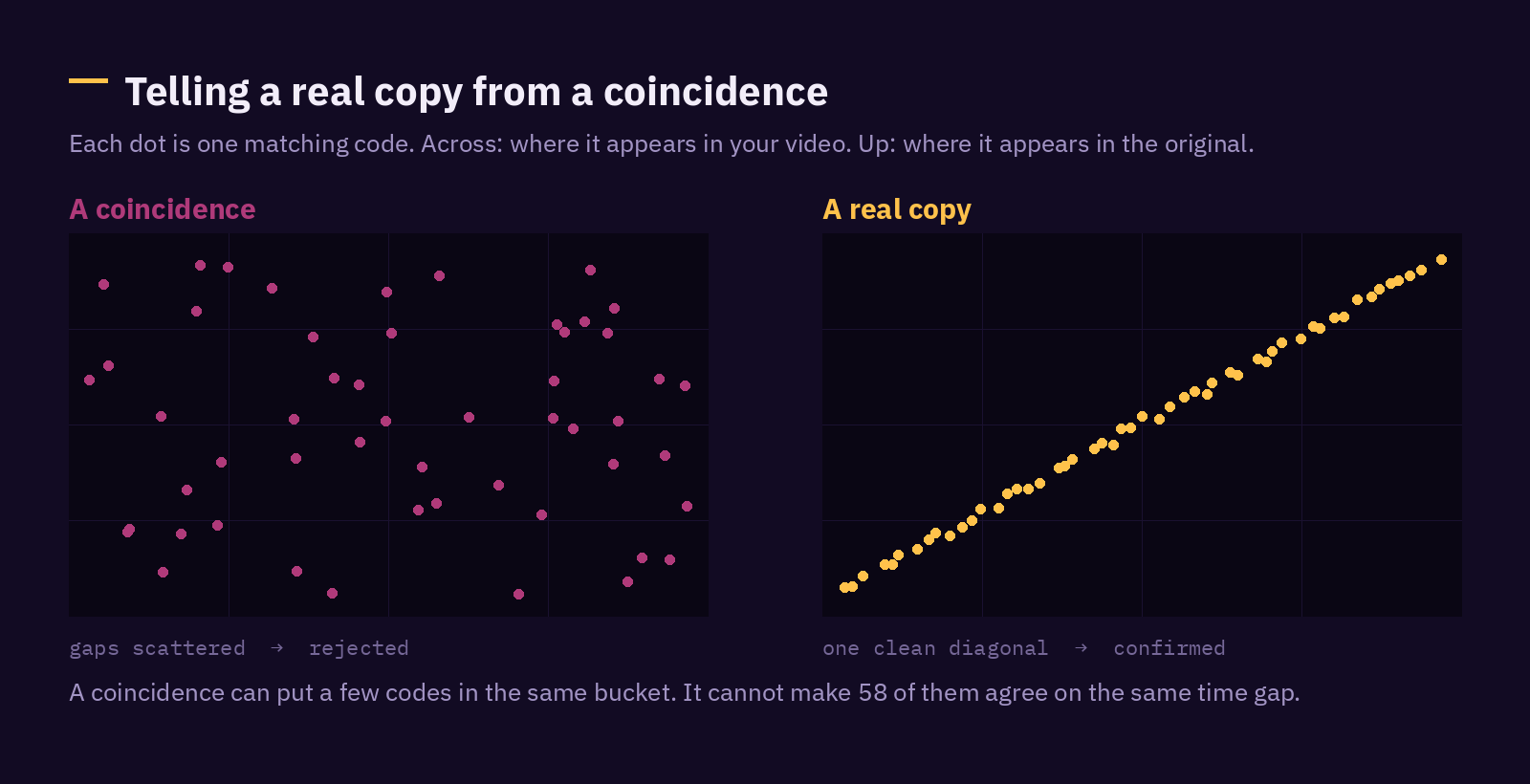
If the matches are coincidental, each one is independent. Code 1 happens to collide with something at 0:12 in the reference. Code 2 collides with something at 3:47. Code 3 at 1:05. The offsets are random, so the dots are scattered all over the plot with no structure.
If the audio is genuinely copied, the relationship is rigid. The copied segment sits at a fixed position in your video and a fixed position in the original, so every matching code is displaced by exactly the same amount. The dots fall on a clean diagonal line.
That's it. That's the test:
A coincidence can put a few codes in the same bucket. A coincidence cannot make 58 of them agree on the exact same time gap.
Why this is the heart of the design
This step deserves emphasis because of what it makes possible architecturally.
The index lookup is fast but unreliable. The verification is reliable but would be far too slow to run against 100 million files. Neither is usable alone.
Put them in sequence and each covers the other's weakness: the fuzzy stage cheaply narrows 100 million candidates to about 40, and the strict stage rigorously examines just those 40. You get the speed of the loose method and the accuracy of the strict one.
The general pattern: a cheap, permissive filter followed by an expensive, strict verifier. This shows up all over large-scale systems — Bloom filters in front of database lookups, approximate nearest-neighbour search followed by exact re-ranking, cheap heuristics before expensive model inference. If you take one transferable idea from this article, take this one.
There's also a nice property in the diagonal itself: if the copy has been sped up or slowed down, the dots still form a line — just at a different slope. A system can detect that and report the speed change, which is why time-stretching is a weaker evasion than people assume.
From match to claim
Everything so far produces one number.
The confidence score
score = (how many codes matched)
      × (how consistently the time gaps agreed)
      × (how long the matched segment was)
For our example: 0.97, against a threshold of roughly 0.85. Comfortably a claim.
Below the threshold, a match doesn't automatically become a claim — it's either dropped or routed to a human reviewer. This is one of the few places where a person re-enters an otherwise fully automatic pipeline.
The threshold is a policy decision, not a technical one, and it encodes a trade-off. Set it low and you catch more infringement but generate more false claims against innocent creators. Set it high and the reverse. There is no setting that avoids both errors; the only question is which error you'd rather make, and who bears the cost of it.
The report is exact
Because every code carries a timestamp, the system doesn't just say "this video matches something." It produces a precise statement:
Matched 8 seconds
04:12 → 04:20  in  my_video.mp4
against reference file  ref_004
That precision is a direct consequence of the fingerprint being a timeline rather than a bag of codes. It's what allows a creator to be shown exactly which seconds of a 10-minute video triggered a claim — and, in turn, what makes it possible to offer "trim this segment" as a remedy.
Then policy runs
The copyright owner chose in advance what should happen when a match is found:
| Policy | What happens |
|---|---|
| Monetise | The video stays up, ads run on it, revenue goes to the copyright owner instead of the uploader |
| Track | Nothing visible happens; the owner just receives viewing statistics |
| Block | The video is made unavailable |
And this is applied per territory. The same claim on the same video can monetise in one country, block in another, and merely track in a third — because the rights themselves differ by country. A label may control a recording in Europe but not in Asia.
A claim is not a strike
Worth stating plainly, because these get conflated constantly and the difference is large:
| Content ID claim | Copyright strike | |
|---|---|---|
| Triggered by | Automated fingerprint match | A formal legal removal request from a rights holder |
| Effect | Money or visibility redirected | Video removed, formal penalty on the channel |
| Channel risk | None by itself | Three strikes typically means channel termination |
| Frequency | Very common, routine | Comparatively rare |
A claim is an automated, reversible accounting adjustment. A strike is a legal action against you. Receiving a claim is not a warning shot before a strike; they're different mechanisms entirely.
Why a five-year-old video gets claimed today
This is the behaviour that confuses creators most, and the architecture explains it in one sentence.
New uploads are matched live, as they're processed. That's the pipeline we've described.
But the reference index keeps growing. New copyright owners onboard. New songs and films get added. And a video uploaded in 2021 was only ever checked against the references that existed in 2021.
So the system also performs batch re-scans: periodically re-checking the existing catalogue against newly added reference files.
2021  ──────────  2023  ──────────  today
you upload        new reference     a batch re-scan
your video        files are added   finds the match
Your video didn't change. The index did.
This is a straightforward consequence of the design rather than a bug, but it has a real cost: it means no upload is ever permanently "cleared." The safety of any given video is provisional, contingent on what hasn't been added to the index yet.
Where this design breaks
Any honest system design includes its failure modes. Here are the ones that follow from the architecture described above.
It can be defeated, and the methods are known
Heavy cropping and mirroring disrupt spatial hashes, because they move every pixel relative to the frame. Mirroring in particular produces a code that has no simple relationship to the original.
Extreme time-stretching eventually breaks audio fingerprints. Modest speed changes shift the diagonal's slope; large ones distort the spectral shape enough that the peaks themselves move.
Adversarial perturbations — noise engineered specifically to move a fingerprint across a bucket boundary while remaining imperceptible to humans — are a known attack on all perceptual hashing. This is an active research area and there is no complete defence.
The architecture assumes an adversary who is careless or casual. It performs much worse against one who is deliberate and technically capable.
False positives are structural, not incidental
I want to be direct about this: a system built on fuzzy matching will produce false claims. Temporal-offset voting reduces them by orders of magnitude but cannot eliminate them, because the underlying method is probabilistic by design.
Known problem cases include public-domain works, royalty-free music libraries, short generic sounds, common chord progressions, silence, and field recordings of natural sound. If a rights holder uploads a reference file containing material they don't exclusively own, everyone who legitimately used that material inherits a claim.
The human gate is a bottleneck and a power asymmetry
The onboarding pipeline's human review is what prevents mass abuse. It's also what makes the system fundamentally asymmetric: one party can make automated claims at scale, and the other party can only respond one dispute at a time, manually. The technical design doesn't create that asymmetry, but it does industrialise one side of it.
I'd call this the most important open design problem in the space, and I don't think fingerprinting technology solves it. It's a governance question wearing an engineering costume.
What creators usually get wrong
A few practical consequences that follow directly from the architecture.
"Under 10 seconds is safe." No mechanism in this design implements a duration exemption. Fingerprints are generated roughly every 46 milliseconds. Duration influences the confidence score, so a very short match may fall below threshold — but that's a probabilistic edge, not a safe harbour.
"I changed the pitch / sped it up / added a filter." The fingerprint summarises spectral shape, which is exactly what these edits preserve. The survival table above shows the numbers.
"I only used it in the background." Background music adds energy to the spectrogram; it rarely removes the peaks that were already there.
"I credited the owner in the description." Credit is not a licence. It has no effect on matching, and no legal effect on permission.
"I can't say a brand's name." This one is backwards, and the distinction is worth being clear about.
Saying "Nike" or "I watched MrBeast's video" is not a copyright matter at all. Copyright protects fixed creative works — a recording, a film, a piece of footage. It does not protect names. Names fall under trademark, which is about consumer confusion: the question is whether your use implies endorsement or sponsorship that doesn't exist. Ordinary commentary, criticism, and review are not that.
Using someone's actual footage, music, or logo is a copyright matter, and that's what the system described in this article detects.
So: the thing people are afraid of (saying a name) is generally fine. The thing people are casual about (using twelve seconds of someone's B-roll) is the one the machine is built to catch.
I'm a software engineer, not a lawyer, and none of the above is legal advice. Copyright and trademark law vary significantly by country, and fair use or fair dealing analysis is fact-specific. If money or your livelihood depends on the answer, talk to someone qualified.
Glossary
Every term used in this article, in one place.
| Term | Meaning |
|---|---|
| Sample | One measurement of air pressure at one instant |
| Sample rate | Measurements per second. CD audio is 44,100 Hz |
| Channel | One audio stream. Stereo has 2 (left and right) |
| Window / frame | A short slice of audio analysed as a unit (here, 2,048 samples ≈ 46 ms) |
| Hop size | How far you slide forward between windows (here, 512 samples), producing overlap |
| Fourier transform | Maths that converts a chunk of a wave into how much energy it holds at each frequency |
| FFT | Fast Fourier Transform — the efficient algorithm that makes the above practical |
| Spectrogram | A picture of sound: time across, pitch up, brightness = loudness |
| Fingerprint | A compact set of codes summarising a piece of media, plus their positions in time |
| Hash | A function turning a large input into a short fixed-size code |
| Cryptographic hash | A hash where any tiny change scrambles the output completely (e.g. SHA-256) |
| Perceptual hash | A hash where similar inputs produce similar outputs — the opposite goal |
| Hamming distance | How many positions two equal-length codes differ in |
| LSH | Locality-Sensitive Hashing — hashing designed so similar inputs share a bucket |
| Bucket | A slot in a hash table; everything hashing to the same value lands together |
| Min-Hash | An LSH technique estimating how much two sets overlap |
| Wavelet transform | Describes an image at multiple scales at once; keeping the largest coefficients summarises its structure |
| Inverted index | Maps content → documents containing it. The core structure behind search engines |
| Shot | A continuous run of video with no cut |
| Keyframe | One representative frame chosen from a shot |
| Temporal-offset voting | Verifying a match by checking that many codes agree on the same time gap |
| Reference file | An original work a copyright owner submitted to be protected |
| Big O notation | Describes how work grows with input size, ignoring hardware and constants |
| O(n × m) | Work grows as the product of two quantities — the shape we had to escape |
| O(log m) | Work grows very slowly as data multiplies — the shape we wanted |
What this is, and isn't
I'll be as precise as I can about the epistemic status of everything above.
What is publicly established
The general architecture of large-scale audio and video fingerprinting is well documented in academic literature and industry practice.
Waveprint (Baluja & Covell, 2008) is a real, published Google paper on audio fingerprinting for copyright protection, using wavelet transforms and Min-Hash.
Spectrograms, FFTs, perceptual hashing, Hamming distance, LSH, and inverted indexes are all standard, textbook techniques. Nothing in the mechanics here is exotic.
YouTube publicly documents the policy layer: eligibility requirements for Content ID access, the monetise/track/block options, territory-specific policies, and the dispute process.
What is my own reasoning
That YouTube uses these specific algorithms. I don't know that. Waveprint is from 2008; a production system nearly two decades later has certainly changed. I cite it because it demonstrates how a Google team approached this problem class, not as a description of current production.
Every number in this article. 200 codes, 0.97 confidence, 0.85 threshold, 193 of 200 surviving re-encoding, ~40 candidates, 61 hits on
ref_004— all illustrative, chosen to be realistic given standard DSP and perceptual-hashing conventions. None are measured from YouTube.The specific pipeline ordering and verification design. This is how I would build it, and how the published literature suggests such systems are built. It is not a description of anyone's actual code.
Why frame it this way
I could have written "here's how YouTube's Content ID works" and it would have performed better. I think that would have been dishonest, and also weaker: an argument that rests on claimed inside knowledge collapses the moment someone asks how you know. An argument that rests on publicly checkable reasoning doesn't.
@Google @YouTube — if any of your engineers read this, I'd genuinely like to know how close it is and where I've gone wrong.
And if you've built similarity search, perceptual hashing, or approximate nearest-neighbor retrieval in production: please tell me what I've got wrong. Corrections are the most useful thing anyone can leave in the comments, and I'll update the article and credit you.
If this was useful, follow along — I write systems breakdowns like this one, aimed at making large-scale architecture understandable without hand-waving.